


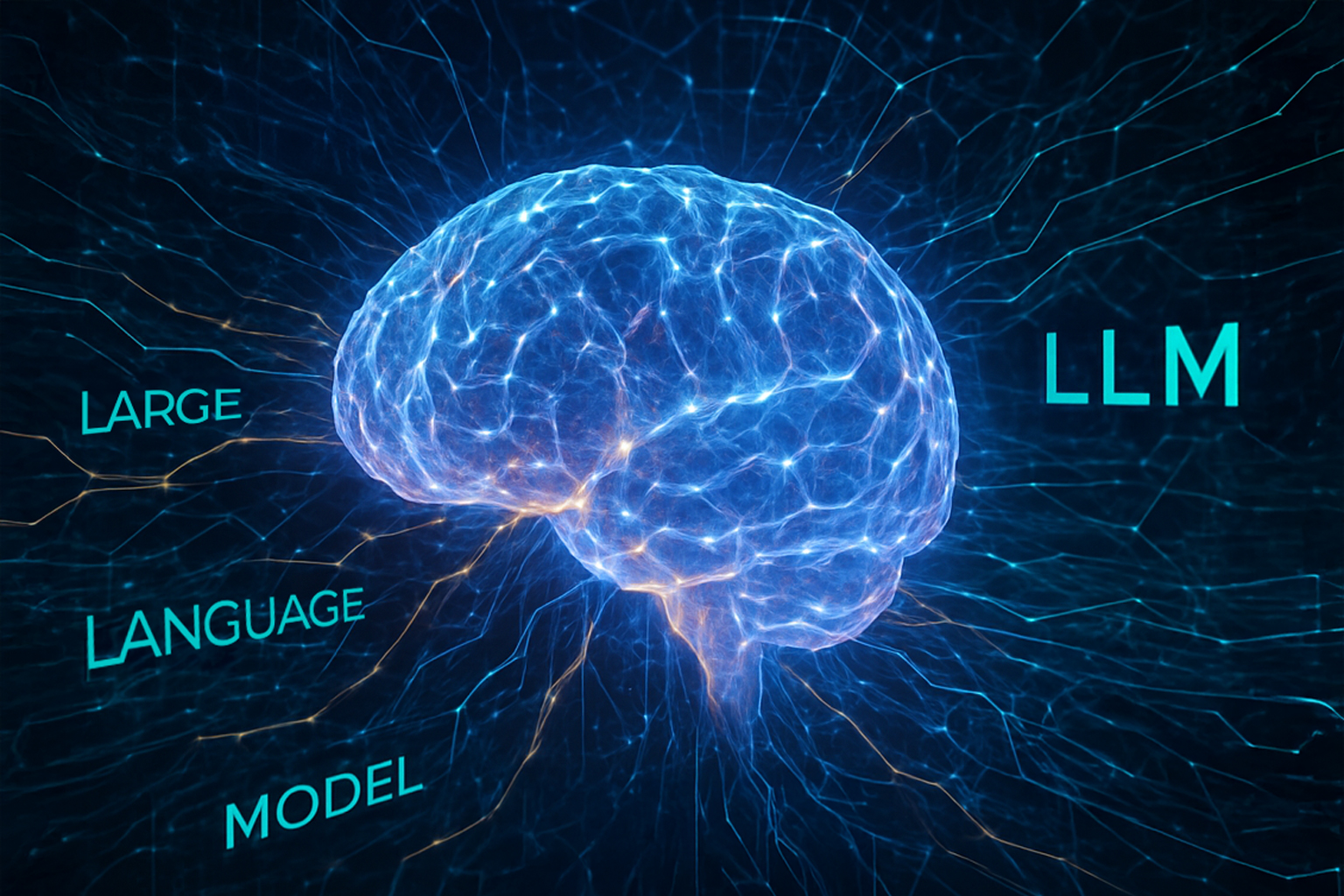
Have you ever wondered how an AI can write essays, translate languages, or answer complex questions with human-like understanding? The magic behind tools like ChatGPT lies in Large Language Models (LLMs), one of the most significant breakthroughs in AI. A Large Language Model is a sophisticated AI trained on vast amounts of text data to understand, predict, and generate language. Think of it as an incredibly well-read assistant that has absorbed millions of books and websites, allowing it to produce coherent and context-aware responses to nearly any prompt you give it.
Table of Contents
A large language model is essentially a computer program trained on vast amounts of text data to understand and generate human-like language. These powerful tools represent one of the most significant breakthroughs in artificial intelligence, fundamentally changing how we interact with technology.
What Is a Large Language Model?
At its core, a large language model definition encompasses neural networks designed to process and generate text by predicting the most likely next word in a sequence. These models learn patterns, grammar, facts, and even reasoning abilities from massive datasets containing billions of words from books, websites, and other text sources.
The “large” in large language models refers to two things: the enormous volume of training data and the massive number of parameters—the internal variables the model uses to process information. Modern LLMs can have billions or even trillions of parameters, making them incredibly sophisticated. This vast scale allows them to function as a powerful, general Wiki on almost any topic, capable of performing tasks for which they were not explicitly programmed.
What makes these systems particularly impressive is their ability to perform tasks they weren’t explicitly programmed for. A single model can write poetry, solve math problems, translate languages, summarize articles, and engage in conversations – all without being specifically trained for each individual task.
How do LLMs Work? The Transformer Architecture
The foundation of modern large language models lies in transformer architecture, introduced in 2017. This revolutionary design allows models to process entire sequences of text simultaneously rather than word by word, dramatically improving their ability to understand context and relationships between distant words in a sentence.
Key components of LLM architecture include:
- Attention mechanisms that help models focus on relevant parts of the input
- Encoder-decoder structures that process input and generate output
- Multi-layered neural networks that enable complex pattern recognition
- Embedding layers that convert words into numerical representations
The training process involves feeding these models enormous amounts of text data and adjusting their parameters to minimize prediction errors. This process requires massive computational resources and can take weeks or months using powerful hardware clusters.
Different Types of Large Language Models
Understanding what are large language models means recognizing that they come in various forms, each designed for specific purposes and applications.
Open Source vs. Closed Source: What’s the Difference?
When discussing what is a closed source large language model, the key distinction is access. Closed source models like OpenAI’s GPT-4 keep their architecture and full training data private. In contrast, open-source models like Meta’s LLaMA or Mistral make their code and often their model weights publicly available, fostering innovation and transparency. For the latest developments in this area, check our AI & Crypto News.
Foundational Models
These are general-purpose LLMs trained on diverse text data to perform various tasks. Examples include GPT-3, GPT-4, and Claude, which serve as the foundation for many applications.
Specialized Models
Some organizations build a large language model from scratch for specific domains like legal documents, medical texts, or scientific literature. These specialized models often perform better in their target areas than general-purpose alternatives.
Large Language Models Examples in Action

Real-world large language models examples demonstrate the versatility and power of these systems:
GPT-4 powers ChatGPT and can engage in conversations, write code, analyze images, and solve complex problems across multiple domains.
BERT revolutionized search engines by better understanding the context of search queries, improving Google’s ability to return relevant results.
Codex specializes in programming tasks, powering GitHub Copilot to help developers write code more efficiently.
PaLM and LaMDA showcase Google’s approach to conversational AI, demonstrating advanced reasoning and dialogue capabilities.
What is Chain of Thought Prompting?
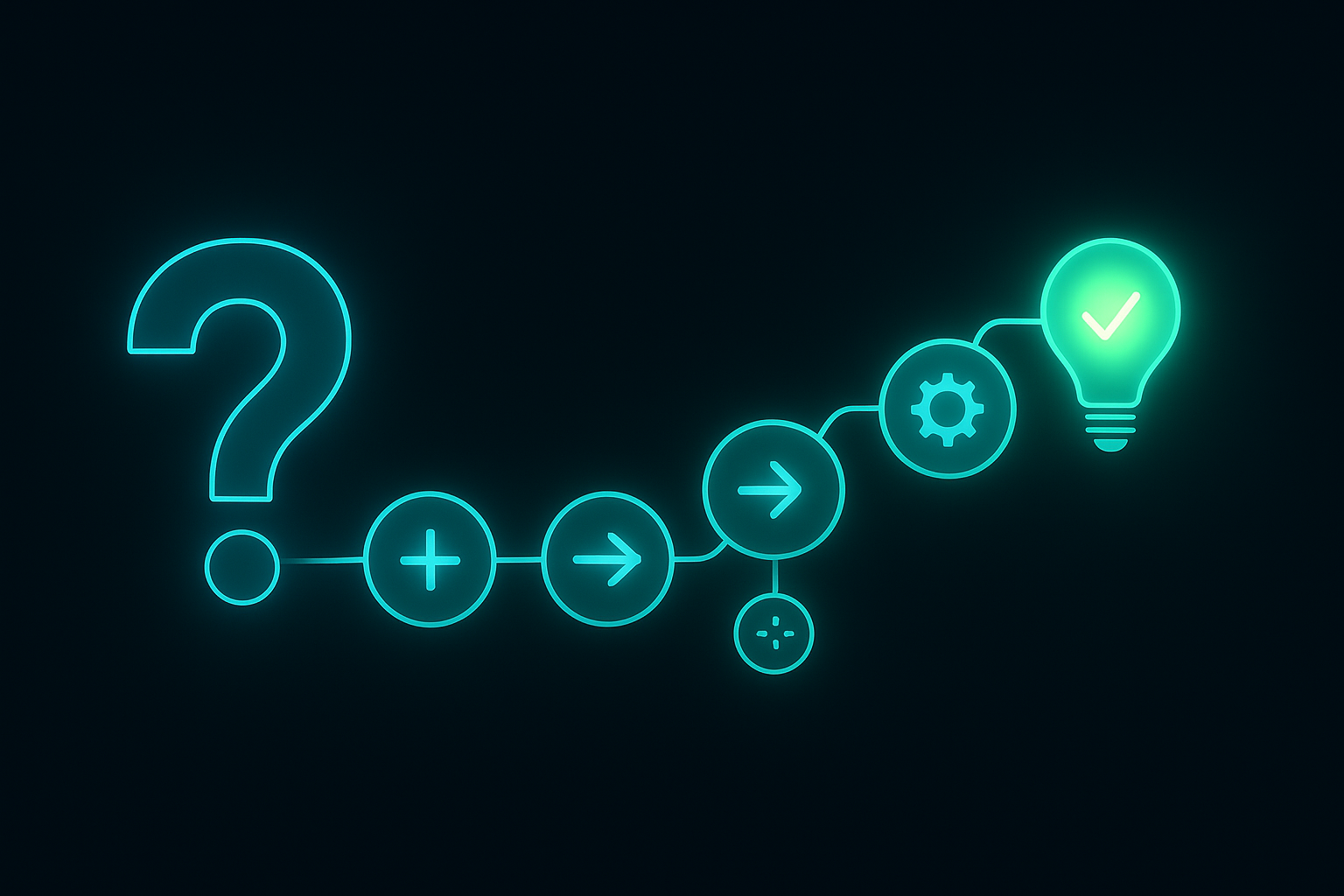
Chain of thought prompting represents a breakthrough technique for improving LLM performance on complex reasoning tasks. Instead of asking models to jump directly to answers, this approach encourages step-by-step thinking, similar to how humans solve problems.
For example, rather than asking “What’s 15% of 240?”, a chain of thought prompt might say “Calculate 15% of 240. First, convert 15% to decimal form, then multiply by 240, showing each step.” This technique significantly improves accuracy on mathematical, logical, and multi-step reasoning tasks.
What is the Meaning of LLM in AI?
To grasp what is LLM in AI, it’s essential to see these models as a convergence of several AI disciplines. They combine natural language processing, machine learning, and deep learning to create systems that can understand and generate human language with unprecedented sophistication.
LLMs represent a shift from narrow AI systems designed for specific tasks to more general AI that can adapt to various challenges. They’re not just pattern matching tools but systems that appear to develop emergent abilities – capabilities that weren’t explicitly programmed but arise from the complex interactions within their neural networks.
How to Build a Large Language Model
The process to build a large language model from scratch involves several critical steps:
Data Collection and Preparation
Training data must be massive, diverse, and high-quality. This typically includes books, articles, websites, and other text sources, often totaling terabytes of information. The data must be cleaned, filtered, and formatted appropriately.
Model Architecture Design
Developers must choose the right architecture, determine the number of layers, attention heads, and parameters. These decisions significantly impact the model’s capabilities and computational requirements.
Training Process
Training involves feeding the prepared data through the model repeatedly, adjusting parameters to minimize prediction errors. This process requires specialized hardware like GPUs or TPUs and can consume enormous amounts of energy.
Evaluation and Fine-tuning
Once trained, models undergo extensive testing and fine-tuning to improve performance on specific tasks or align with human preferences and safety guidelines.
Applications and Impact
Large language models are transforming numerous industries and applications:
Content Creation: Writers use LLMs for brainstorming, editing, and generating drafts across various formats.
Education: These models serve as tutoring assistants, helping students understand complex topics and providing personalized learning experiences.
Customer Service: Many companies deploy LLMs to handle customer inquiries, providing instant, accurate responses around the clock.
Programming: Developers leverage these models to write code, debug programs, and learn new programming languages.
Research: Scientists use LLMs to analyze literature, generate hypotheses, and accelerate discovery processes.
Challenges and Limitations
Despite their impressive capabilities, large language models face several significant challenges:
Computational Requirements: Training and running these models requires enormous computational resources, making them expensive and energy-intensive.
Bias and Fairness: Models can perpetuate biases present in their training data, potentially leading to unfair or discriminatory outputs.
Hallucinations: LLMs sometimes generate plausible-sounding but factually incorrect information, making verification crucial.

Interpretability: Understanding why models make specific decisions remains challenging, limiting trust in critical applications.
Future Developments
The field of large language models continues evolving rapidly. Researchers are working on more efficient architectures, better training methods, and improved alignment with human values. Future developments may include:
- Multimodal models that process text, images, and audio simultaneously, potentially impacting everything from art to decentralized finance within the Crypto space
- More efficient training methods that reduce computational requirements
- Better reasoning capabilities that approach human-level problem-solving
- Specialized models for specific domains and applications
Frequently Asked Questions
What is a Large Language Model (LLM)? An LLM is a type of AI trained on massive amounts of text to understand and generate human-like language. It works by predicting the next word in a sequence, allowing it to write, translate, and answer questions.
What does LLM mean in AI? In AI, LLM stands for “Large Language Model.” The term “large” refers to the model’s immense scale, both in the data it’s trained on and its internal parameters, which you can learn more about in our section on LLM architecture.
What are some examples of Large Language Models? Famous large language models examples include OpenAI’s GPT-4 (powering ChatGPT), Google’s Gemini, and open-source models like LLaMA. Each has unique strengths for different applications.
What is the difference between open and closed source LLMs? A closed source large language model like GPT-4 is proprietary, while open-source models make their code public, fostering community collaboration. The choice impacts transparency and customization, a topic we often cover in our AI & Crypto News.
Large language models represent a transformative technology that continues reshaping how we interact with artificial intelligence. As these systems become more sophisticated and accessible, they promise to unlock new possibilities across countless applications while challenging us to address their limitations responsibly.

This is a test comment:
https://www.diffchecker.com/